
Can your divot really tell you what went wrong? Absolutely. The turf doesn't lie, and once you know what to look for, you'll diagnose swing faults faster than any launch monitor.
✅ Best for: Mid-to-high handicappers wanting instant feedback
✅ Time to master: One range session to understand the basics
When you hit an iron shot, the turf tells a story your eyes might miss. While ball flight shows you where the ball went, your divot reveals why. I've spent over 20 years watching golfers ignore these clues, and it costs them strokes every round.
By learning to read these marks in the grass, you can diagnose your swing instantly without expensive technology.
1. Divot Location: Ball First, Turf Second
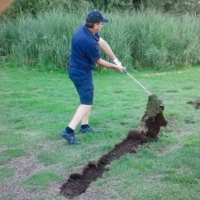
The most common fault I see with amateur golfers is striking the ground before the ball. Where your divot starts tells you everything about your strike quality.
What to Look For
✅ Perfect Divot: Starts roughly 2-3cm after the ball position. This indicates a descending blow that compresses the ball for maximum distance.
❌ Fat Shot Divot: Starts behind the ball, meaning your swing bottomed out too early, usually from stalled hip rotation or an early release.
Want to Practice on Perfect Fairways?
Stop hitting off mats. Join our fully escorted golf tours to Thailand, Vietnam & Mauritius. We handle the flights, hotels, and tee times - you just bring your A-game.
View Upcoming Tours
2. Divot Direction: Slice or Hook?
Your divot acts like an arrow pointing to your swing path. Stand behind it after your shot and you'll see exactly where your club was travelling through impact.
Reading the Direction
⬅️ Pointing Left (for right-handers): An "out-to-in" swing path. If the face was open you hit a slice; if closed, you pulled it straight left.
➡️ Pointing Right: An "in-to-out" swing path. This generally produces a draw (good) or a push/hook if it's excessive.
✅ Pointing Straight: A divot aimed directly at the target is the gold standard for penetrating iron shots.
3. Divot Depth: Bacon Strip vs. Crater
Are you digging a grave or peeling a strip of bacon? The depth of your divot reveals your angle of attack, and it matters more than most golfers realise.
Depth Analysis
❌ Deep and Narrow: You're coming in too steep, essentially "chopping wood". This minimises your margin for error and you need to shallow out your swing.
❌ Uneven Depth: If the divot is deeper on the toe or heel side, your clubface isn't meeting the turf squarely, often leading to shanks or weak glancing blows.
✅ Uniform and Shallow: The ideal divot looks like a dollar bill or a strip of bacon: shallow, rectangular, and consistent, showing a square clubface with proper angle of attack.